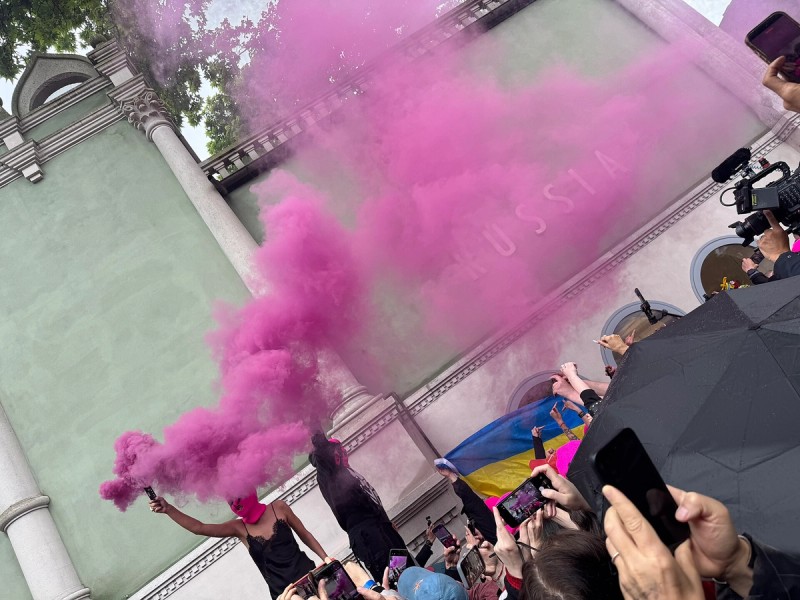
Protester vid ryska paviljongen, Venedigbiennalen 2026.
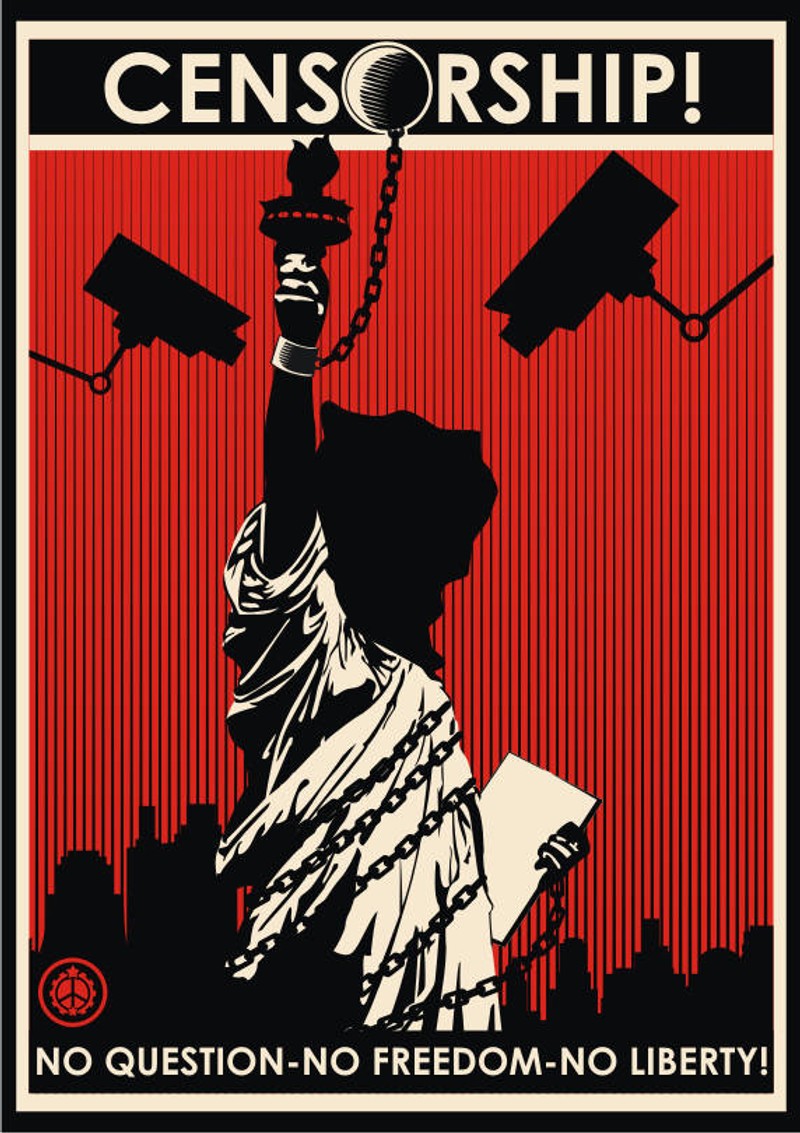
There is an old joke Slavoj Žižek likes to tell. A man goes to the doctor and says: “Doctor, I think I am a fascist.” The doctor replies: “Tell me more.” The man says: “I believe in the absolute purity of the nation, the cleansing of inferior races and the submission of the individual to the will of the state.” The doctor nods slowly and says: “That is serious. But tell me, does this belief interfere with your work?” The man brightens: “Not at all! I run a very successful contemporary art gallery in Berlin.”
I actually made this joke up. But Žižek would approve, I think, even if the relationship between the art world and fascism is much more complicated. The invention of the white cube, with its belief in purity, order and exclusion, was in itself if not a fascist, at least a racist invention. Charlotte Klonk claims in her book Spaces of Experience: Art Gallery Interiors from 1800–2000, that the white cube as a standardized practice emerged in Germany during the Nazi period in the 1930s, and that we could thus see the white cube as a Nazi invention. This courageous argument was grounded in her analysis of how the Third Reich’s cultural institutions deliberately stripped exhibition spaces of ornament and historical reference, producing a neutral, depoliticized aesthetic that paradoxically served a highly ideological purpose: to elevate and purify so-called “true” German art while contrasting it with the cluttered, context-heavy displays associated with degenerate or foreign influence. In that sense, Nazism was not a political programme that happened to have good aesthetics, but an aesthetic programme that happened to seize political power. The Nuremberg rallies were designed to overwhelm the senses, dissolve the self, search for the absolute and produce the sublime. Walter Benjamin understood this better than anyone else. In the epilogue to ”The Work of Art in the Age of Mechanical Reproduction”, he wrote that fascism was basically the aestheticization of politics which enabled it to belong to something larger, purer, more absolute than individual life. Isn’t the artworld producing the same thing? Yes, but in a different way.
It’s obvious that the artworld has been captured by capitalist and quasi-fascist structures. The art market concentrates enormous wealth and cultural power in the hands of a tiny oligarchy. Of course, this offers artists a way to survive, but what is sold is a feeling of being part of something larger, one that overrides any shame about how the money was earned. Spectacle and substance often exist at the same time, without annihilating each other. Art fairs like Art Basel resemble the kind of grandiose display fascism used to project power and prestige. And certain trends in contem porary art share uncomfortable features with fascist aesthetics: the cult of the singular genius artist (Damien Hirst, Jeff Koons and others) as an almost superhuman figure with monumental, overwhelming installations designed to produce awe and submission rather than reflection. Art, branding and symbolic power blend into a seamless spectacle, produced by artists and art professionals.
What Benjamin valued was something far more demanding than beauty or entertainment. He championed an art that refuses aesthetic consolation, treating every aesthetic choice as inherently political. The Brechtian theatre he admired in ”What is Epic Theater?” was built on this principle: rather than offering audiences an absorbing emotional experience, it sought to provoke thought and criticality. This is why Brecht rejected the catharsis that Aristotle praised in his writings about theatre. This ancient release of tension through emo tional identification with the hero, or anti-hero, is, in Benjamin’s implicit framework, not a liberating experience but a pacifying one. It discharges the very tension that might otherwise drive people to act. The spectacle absorbs the impulse for change rather than directing it outward.
This carries a sharp relevance for the contemporary art world. When art institutions today stage politically charged works – addressing migration, racial violence, ecological collapse, or economic inequality – within the immaculate, neutralizing environment of the white cube, or other spaces for that matter, the risk is precisely this: that the aesthetic packaging transforms potential discomfort into cultural consumption. Visitors leave feeling they have engaged with something difficult, when in fact the institutional frame has quietly performed its own catharsis on their behalf. Let’s consider what has happened since Russia’s invasion of Ukraine on February 24, 2022, and even more so since October 7, 2023. The art world has been violently shaken by boycotts, open letters, cancellations, the withdrawal of prizes, the shaming of collectors, curators and museum directors, in a chain of guilt-by-proximity that would be familiar to any student of the Stalinist show trials. It is not an exaggeration to say that the desire to keep art pure is itself a fascist impulse. The dream of a totalizing art world – cleansed of contamination, unified in its moral verdicts, policing the boundaries of the permissible – carries its own authoritarian pleasure. The fantasy of the art world as a totality, speaking with one voice, is not a radical, but a highly conservative aspiration.
documenta fifteen (2022) makes this contradiction uncomfortably visible. The exhibition, organized by the Indonesian collective ruangrupa, was conceived as a genuinely decolonial project – plural, horizontal, refusing the Eurocentric hierarchies that have structured the art world for centuries. When the Indonesian collective Taring Padi exhibited their large banner People’s Justice (2002) – a work originally meant to depict violence under the Suharto dictatorship – it was found to contain antisemitic imagery, including a caricature of an orthodox Jew and a Mossad agent depicted with a pig’s head. The work was immediately removed, and documenta’s general director Sabine Schormann was forced to resign. The artist Hito Steyerl publicly withdrew her own works from the show in protest and the documenta organization had to face the uncomfortable question of whether its celebrated model of radical openness had simply been openness to anything, including hatred. But the spectacle of the German state – with its particular historical relationship to both antisemitism and cultural censorship, but also of necropolitics which destroyed itself, as Vladimir Safatle points out in his book Beyond the Necropolitics Principle: Suicidal State and Authoritarian Neoliberalism (2020) – appointing itself the guardian of artistic acceptability was not without its own dark irony. German Culture Minister Claudia Roth declared that artistic freedom had reached its limit. One could argue that in that moment the German state performed its own variety of authoritarianism: the state deciding what art may and may not say, and doing so, characteristically, in the name of protecting culture from itself.
Can one go so far as to claim that the German state has itself become fascistic in its exclusion and boycotting of any artist who dares to critique Israel, by equating such critique with antisemitism? The weight of Germany’s particular historical burden makes this an extraordinarily fraught question. A country that built its postwar identity on the imperative of “never again” has found itself deploying the memory of the Holocaust as a shield against accountability. The instrument of moral memory has been turned into an instrument of political enforcement. These are not the tools of a liberal democracy protecting a minority, but the tools of a state deciding what may and may not be said. That this is happening in Germany, of all places, and in the name of historical memory, of all justifications, is not an irony that should pass without remark.
But there are also cultural events that are more permissive. Russia and Israel will have national pavilions at the 2026 Venice Biennale. Predictably, calls for boycotts have followed. Nearly 200 Venice Biennale participants have signed a letter demanding cancellation of the Israeli pavilion. Signatories include the artists Alfredo Jaar, Yto Barrada, Rosana Paulino, Meriem Bennani and Cauleen Smith, along with the curators such as Binna Choi and Carles Guerra. These calls rest on a legitimate concern: that artistic participation can normalize genocide, fascism, and state violence by lending them cultural legitimacy. This demand seems to assume that the Biennale stands on ethically clean ground – an assumption worth questioning. Founded at the height of European colonialism, the event has long aestheticized and normalized state power, not to mention its fascist period where Nazis and Fascists were not merely tolerated but celebrated, their pavilions treated as equal participants in an international cultural conversation, the Biennale’s cosmopolitan framing quietly laundering the respectability of regimes that would soon be responsible for the deaths of tens of millions. The Venice Biennale’s organization has consistently maintained that it does not have the authority to exclude nations that enjoy diplomatic recognition from the Italian government. The Biennale has stated that it “rejects any form of exclusion or censorship of culture and art” and describes itself as “a place of dialogue, openness, and artistic freedom.”
One thing is sure – the art world has become a theatre of the absolute. It has organized itself around the fantasy of a position of total moral purity – what Lacan, in his 1959-60 seminar The Ethics of Psychoanalysis, calls the figure of the “beautiful soul”, which is always complicit in the very evil it denounces, because its denunciation is a way of maintaining its own purity rather than actually transforming anything. The art world’s obsession with moral positioning is, in Lacanian terms, an obsession with the fantasy of the Other without lack, a non-dialectical moral order in which every object, every person, every institution can be definitively sorted into the pure and the impure. This is, structurally, the same fantasy that animates fascism, through longing for an absolute that will resolve the unbearable ambiguity of real political life. Benjamin’s aestheticization of politics has become, in the contemporary art world, the “aestheticization of ethics.”
By this, I mean that ethics has ceased to function as a mode of thinking and has become a mode of display. Just as Benjamin warned that fascism turns politics into a spectacle, the contemporary art world has turned ethical commitment into a performance. The open letters, the boycotts, the public withdrawals, the accusations and the statement of solidarity are not primarily instruments of political change, but gestures that produce an aesthetical jouissance, the feeling of belonging to something higher than oneself – the absolute. This aestheticization of ethics has a further consequence. Once ethics becomes spectacle, what matters is no longer the complexity of a position but its legibility, where ambiguity reads as complicity. The ethical performer must be immediately recognizable as being on the right side, which means that the very act that genuine ethical thought demands – sitting with contradiction and the refusal of easy resolution, becomes not a virtue but a suspicious sign. In this way, the aestheticization of ethics does not produce more ethical behaviour, it actually destroys it. Certainty becomes then the proxy for virtue, leading to a form of natural selection that works against depth. Ethics thus becomes a form of social positioning, and the question shifts, almost imperceptibly, from what is right to what will read as right.
Alberto Toscano, in his essential Fanaticism: On the Uses of an Idea (2010), traces fanaticism from the religious wars of the sixteenth century through the French revolution. Toscano is interested in the moment when political passion tips into what he calls abstract violence, that follows the logic of absolute purity. From the Jacobins to Lenin, the logic is identical: the particular, the ambiguous, the merely human, is sacrificed to the absolute. But there is another phenomenon worth noticing. While Western art institutions have been tearing themselves apart over questions of purity through acts of inclusion and exclusion while maintaining the same institutional structure, the Gulf states have been quietly building a new global art infrastructure. Art Dubai, the Louvre Abu Dhabi, and the Guggenheim Abu Dhabi represent a genuine shift in the geography of art. Artists and galleries burned by the Western culture wars have found in the Gulf a market that asks fewer political questions and charges lower emotional taxes. That image of the enlightened Middle East as Disneyland for grown-ups has however taken damage.
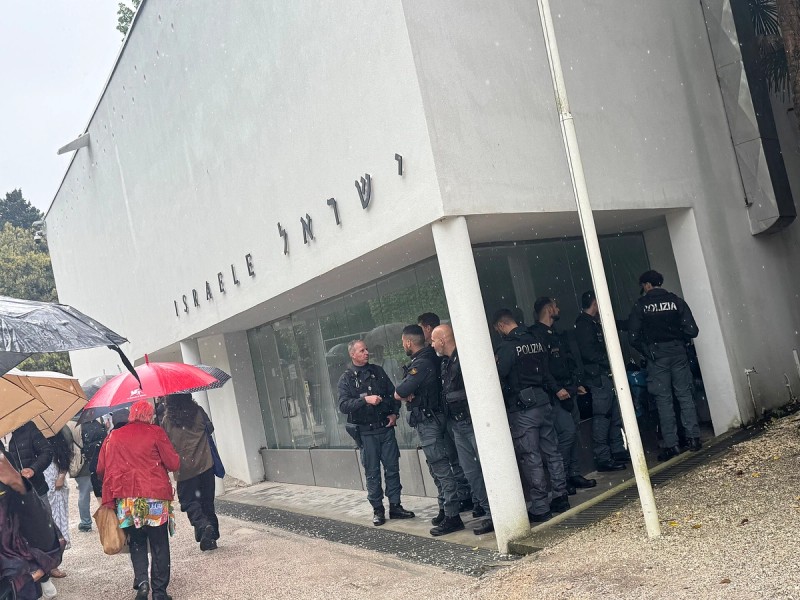
Polisbevakning av israeliska paviljongen, Venedigbiennalen 2026.
Since the US and Israeli strikes on Iran in early March, which triggered retaliatory Iranian bombing of Qatar, Dubai, and the wider Gulf region, the carefully constructed fiction of the Gulf as a space somehow outside of geopolitics has collapsed. The art world’s last capitalist paradise – Abu Dhabi, Dubai, the whole apparatus of sovereign wealth and cultural prestige – is beginning to look like what it always was: not an exception to history, but a temporary suspension of it.
Here is where Benjamin becomes indispensable again. The Gulf’s cultural project is, in his precise sense, the most thorough- going aestheticization of politics currently operating anywhere in the world. The Louvre Abu Dhabi is not primarily a museum. It contributes to the transformation of a petro- state into a bearer of universal culture, a legitimate player in the game of historical meaning. The irony here is that artists fleeing the politicization of the Western art world are landing in a space that is more thoroughly politicized than anything they left behind, since migrant workers are exploited on a staggering scale, LGBTQ+ people face legal persecution, and freedom of expression is strictly limited. What the Gulf practices is something older – and in some ways – more stable: the management of populations by a ruling class that has never needed to mobilize mass desire because oil revenue has made popular consent optional. Several scholars have pointed to a growing fascination among parts of Silicon Valley’s tech elite with political systems where capital operates with limited democratic control.
Historian Quinn Slobodian argues that libertarian economists and investors have long explored political and economic arrangements designed to separate markets from democratic regulation, including special economic zones, charter cities, and privately governed territories. In these spaces, one can trace the emergence of a new form of “purity”, where economic life is stripped of democratic friction and recast as a domain of technical management. Democracy appears here as noise, as interference in the smooth operation of markets. What follows is not simply deregulation, but the active production of insulated zones where collective rights are treated as external threats. In this sense, these new art and economic zones do not just evade democracy. They reframe it as a problem to be contained, if not excluded altogether.
A frequently cited expression of this position comes from venture capitalist Peter Thiel, who wrote in 2009 that he no longer believed that “freedom and democracy are compatible.” Within this discourse, wealthy authoritarian states and experimental economic zones frequently appear as working models, proving that technological development and capital accumulation can proceed perfectly well without demo cratic governance. If Western art and its institutions were always dependent on state violence to begin with, it should perhaps come as no surprise that the art world is adapting without great difficulty to a multipolar order in which democratic and non-democratic states sit side by side comfortably.
We could perhaps talk about a “smooth fascism”, or of a “fascism with a human face”, since we should always think of fascism and capitalism as the two sides of the same coin. As Max Horkheimer wrote in his essay from 1939 entitled ”Jews and Europe”: “Whoever is not prepared to talk about capitalism should also remain silent about fascism.” Alberto Toscano continues this idea in his book Late Fascism: Race, Capitalism and the Politics of Crisis (2023) arguing that fascism must be understood as anchored in racial and colonial capitalism, which was the case for both Mussolini’s Italy and Hitler’s Germany, and he insists, fascism is a mutable process that continues to evolve in the present. Even Gilles Deleuze and Félix Guattari warned in their book, A Thousand Plateaus, which was published in 1980 – as relatively benign postwar capitalism was being swept away by the wilder, harsher version of the Thatcher-Reagan era, that too much capitalist acceleration could suck society into “black holes” of fascism and nihilism. How does one avoid becoming fascist, even when one believes oneself to be a revolutionary militant, or at least a democratic socialist?
What could we say about fascism from a psychoanalytical point of view? Let’s take another Žižekian joke, namely the one about a man who visits a psychiatrist and insists that he is a grain of corn. The psychiatrist, after months of work, finally convinces him that he is a human being, but the man returns to the doctor five minutes later, trembling, claiming that there is a chicken outside, the doctor says: “But you know you are a human being, not a grain of corn.” “I know that,” the man replies. “But does the chicken know?” This joke is, for Žižek, a parable of ideology. Knowing something rationally does not protect you from its effects. The fascist voter who “knows” that immigrants are not really stealing his enjoyment – that is, displacing him from his job, eroding his culture, or threatening his sense of social belonging – still votes as if they were, because the level at which fascism operates is not the level of rational belief, but the level of what Lacan calls jouissance – that peculiar, excessive satisfaction that is inseparable from anxiety and pain, the enjoyment that we cannot acknowledge as enjoyment.
The art world has always been, among other things, a place of jouissance, which explains the strange loyalty so many of us maintain toward it despite knowing its history. We know its racial legacy, its entanglement with state violence, its capture by capital. And yet we return. Boycotts and exclusions are, in this light, not simply political gestures but attempts to protect this enjoyment. But the jouissance at stake here is not mere comfort or social belonging. It is tied to something more destabilizing: the experience of a space in which the existing organization of society could be imagined otherwise, in which the boundary between productive and unproductive life, between the governed and the ungovernable could be temporarily suspended. This suspension, however compromised, however captured by capital and state, is the site of a genuine agonism that Chantal Mouffe theoretizes in Agonistics: Thinking The World Politically (2013), and it is worth fighting for, even knowing what we are fighting within. It is a jouissance tied to the possibility – however deferred, however ideologically mediated – of a different organization of collective life. I do not want anyone to take that from me. But I am also aware that clinging to it, without confronting what sustains it, may be precisely the mechanism by which that possibility is endlessly postponed.
Žižek’s most distinctive contribution to the theory of fascism, developed across The Sublime Object of Ideology (1989), The Plague of Fantasies (1997), and The Parallax View (2006), is his insistence that fascism is, at its deepest level, not an ideology but an economy of jouissance. The fascist community does not cohere around shared beliefs, shared interests, or even shared identity. It coheres around a shared fantasy about enjoyment: the fantasy that the Other – the Jew, the immigrant, the foreigner, the gender deviant, is stealing from us something that is rightfully ours. Not our jobs, not our houses, not our literal material goods (though it presents itself that way). What is being stolen is our enjoyment itself, our sense of being at home in the world and of living a full and satisfying life. And yet, within the art world, there remains a specific form of enjoyment that persists through its contradictions. You move through openings, studios, and conversations aware of precarity, institutional compromise and uneven visibility and power. Still, there is a shared intensity, a way of gathering around works and ideas that resist clear function or agreement. This enjoyment is not innocent. It carries knowledge of its own conditions. It also produces a strange sense of home, one that no one fully inhabits. You recognize the codes, the gestures, the spaces, and for a moment they hold. But the feeling never settles. It remains partial, unstable, marked by exclusion as much as belonging. That tension does not dissolve the experience. It defines it.
This fantasy of stolen jouissance is what Lacan analysed in his concept of the “theft of enjoyment.” In the seminar The Other Side of Psychoanalysis (Seminar XVII, 1969-70), Lacan elaborates how surplus jouissance, the excess enjoyment that the social order both stimulates and forbids, is always displaced onto a figure who is imagined to have access to it illegitimately. The Jew in Nazi ideology is precisely thisfigure: imagined as having too much and enjoying too freely. The fantasy is not about what the Jew actually does. It is about the fascist subject’s own relationship to enjoyment, which is profoundly ambivalent, and perhaps inhibited by a too strong Super Ego. The Jew is the screen onto which this ambivalence is projected and resolved: if we could get rid of him, we could enjoy as we should. This is why, Žižek insists, rational counter-argument fails against fascism. You cannot debunk a fantasy about enjoyment with facts, because the fantasy is a structural necessity of the subject’s psychic economy. Telling the anti-Semite that Jews do not actually control the banks, or the Trumpist or the current regime of Sweden that immigrants do not actually take more than they give, is like telling the man that he is not a grain of corn. He knows, but the chicken – a poignant image of the big Other.
Žižek also makes, in The Sublime Object of Ideology, a point about fascist belief that is both funny and devastating. Drawing on Peter Sloterdijk’s concept of “cynical reason”, he argues that the characteristic mode of late ideological belief is not naive conviction but what he calls “I know, but still”, which is actually the psychic structure of perversion. The cynical fascist, the one who says he doesn’t really believe in all that race stuff, he just likes the energy of the movement, or the irony, or the transgression, is not for Žižek less ideologically captured than the true believer. He is more than so, since his cynicism is the final protection against recognizing what he is actually doing. The man who marches in a fascist parade while assuring himself he is just trolling around is performing the ideology more completely than the one who marches in earnest conviction. Ideology, Lacan taught us, lives not in what we think but in what we do. This cynical structure is precisely what sustains the art world’s hold today. We know about the complicity, the entanglement with capital and state violence, and we continue. But cynicism has its limits. When those limits become visible, as they did at documenta 15 and in the institutional prohibition against criticizing Israel, the identification cracks. What is threatened in such moments is not only political consensus but the enjoyment tied to belonging.
On the contemporary far right, Žižek’s analysis has remarkable precision. The ironic racism of the alt-right a few years ago, the shitposting, the Pepe memes, the elaborate performance of edginess-as-art, was not, as its participants claim, a postmodern detachment from ideology. It was ideology’s most sophisticated contemporary form: the one that has learned to protect itself against critique by preemptively performing its own distance from itself. Žižek has argued, in more recent essays and in Pandemic! COVID-19 Shakes the World (2020) and elsewhere, that Trump represents not classical fascism but what he calls “post-fascism” or “fascism with a democratic face.” Classical fascism required genuine mass mobilization and organizational discipline and a revolutionary ambition to seize and transform the state. What Trump offers is fascist affects – the fantasy of the nation’s stolen jouissance to be reclaimed, the figure of the enemy within the country’s borders, the pleasure of collective transgression and the elimination of all world leaders that don’t play by his rules. It is fascism as entertainment, as reality television, as a jouissance-delivery mechanism that operates through the existing democratic infrastructure rather than against it. Benjamin might have called Trump the ultimate consummation of his diagnosis: a fascism so thoroughly aestheticized that it presents itself as a TV show.
What is the art fair if not a jouissance-delivery mechanism of its own: a space where transgression is packaged, priced, and made safe for consumption, where the frisson of the controversial is extracted from any genuine risk and sold back as cultural capital? The collector who buys work that gestures toward radical politics performs the same structural operation as the rally attendee: both receive the pleasure of identification with something that feels transgressive while remaining entirely within the system that produced them. Benjamin understood this logic avant la lettre. When he wrote that fascism aestheticizes politics, he was not making the narrower claim that fascism is merely decorative or that it cynically deploys beauty as propaganda, though it does both. He was making the deeper structural claim that aestheticization is itself a mode of neutralization: that when political content is processed through the categories of aesthetic experience, it is simultaneously elevated and defused.
On the question of anti-fascism, and this is where Žižek becomes most controversial, and most useful, he warns us that the liberal anti-fascist consensus operates as an ideological trap. By presenting fascism as the supreme political evil, the absolute limit beyond which no decent person can go, liberal anti-fascism makes liberal capitalism appear as the natural baseline of decency, the thing we return to when we have successfully resisted the fascist temptation. This is, Žižek argues, profoundly convenient for those who benefit from the existing order, because it forecloses any more radical critique. To question capitalism too vigorously is to risk the accusation of creating the conditions for fascism. The anti-fascist consensus thus becomes a way of protecting the very system whose failures produce fascism in the first place, but what is the true difference between fascism and anti-fascism? The murder of Quentin in France, on February 14, 2026 – beaten to death by people identifying as anti-fascists – was seized upon by politicians and commentators as proof that the left had become what it claimed to oppose. What the event actually reveals, however, is something more uncomfortable: that the psychic structure underlying fascist violence – the dissolution of the individual into the righteous collective, the designation of an impure enemy, the libidinal release of aggression under moral permission, does not belong to any political label, and that the left, which is rightly horrified by fascism, has not been equally rigorous in recognizing that structure in its own most passionate moments. What can we say about this from a psycho analytical point of view?
Wilhelm Reich’s Mass Psychology of Fascism (1933) remains the most radical psychoanalytic account of fascism ever written precisely because it refuses to treat fascism as primarily ideological, arguing instead that Nazism succeeded because it offered a libidinal solution to the crisis of what Reich called the “armoured body” – the nearly universal condition of Western subjects whose capacity for spontaneous bodily and sexual experience had been suppressed since childhood, transforming desire into free-floating aggression available for political redirection. What the aesthetics of Nazism – from the homoerotic charge of the Hitler Youth to Riefenstahl’s cinematographic pornographies of power – reveal is the sexual economy at fascism’s core: desire systematically aroused and simultaneously forbidden, its energy harvested not for pleasure but for collective submission to an absolute. Lacan reframes Reich’s hydraulic model of desire with precision: desire is not a pressure seeking release but a relation to lack, always structured by fantasy and the Other’s gaze. No amount of sexual liberation can resolve this, because the liberated body does not become a free subject – it becomes a desiring subject, one whose desire remains organized around the impossible object Lacan calls the objet petit a, and whose unleashed energy will always harbour the opposition Freud discovered with Sabina Spielrein’s help: Eros and Thanatos simultaneously. Freud’s most unsettling insight was not that these two forces are in conflict, but that they are inseparable, that every erotic investment carries a destructive underside, that the most intense attachment already contains within itself the impulse toward annihilation of its object, and that civilization, which is Eros’ great project, generates by that very fact an accumulation of repressed aggression that must go somewhere.
What Lacan’s four discourses add to this is a structural account of how power organizes enjoyment. The Discourse of the Master presents a subject who submits to an absolute signifier in order to conceal his own inner division – a structure recognizable in both Hitler and Trump, whatever their differences. The Discourse of the University presents neutral knowledge as a mask for the master signifier lurking behind it – the hidden ideology embedded within every claim to objectivity. The Discourse of the Hysteric presents the divided subject provoking the master into producing knowledge – as in Lacan’s reading of May 1968, a revolt that, without passing through The Discourse of the Analyst, simply installed a new master. It is in the Analyst’s discourse alone that this circuit is interrupted: the analyst, feigning ignorance, occupies the place of the objet petit a, allowing the subject’s desire to speak for itself rather than be captured by a new authority.
The Discourse of the Analyst is the only one in which the master signifier appears not as given authority but as something the subject itself produces, which is why psychoanalysis remains, for Lacan, the only discourse that does not secretly reproduce domination. The four discourses describe the mechanisms of the social bond. What does this mean for fascism? It means that fascism’s appeal is not primarily about the repression of sexuality but about the structure of fantasy itself. The fascist fantasy – the nation as pure body, the leader as the one who has full access to jouissance, the enemy as the one who steals it – is powerful because it offers what the neurotic, divided subject most deeply wants: a consistent Other without lack, a world in which the ambiguity and incomplete ness of desire are finally resolved. This is what I call the “seduction of the absolute”: the fantasy of a completeness that the structure of the speaking subject always precludes, offered by fascism as a political reality. And what I have tried to say is that this tendency also exists in relation to the art world. It cannot be delivered, of course. No actual political movement can deliver completeness. But the promise is enough. In that sense, one could argue that all political parties contain, to varying degrees, tendencies that seek to discipline, order, and secure the social body. Without diminishing the organized violence of historical fascism in Germany and Italy, or the fascistic dimensions of colonial violence within European empires, we might instead ask how similar logics persist in more diffuse and normalized forms within contemporary political life.
There is no easy way out of fascism today, especially not if we think of the techno-fascism that is taking over our world, which Catherine Malabou so brilliantly theorizes in a short video announcing her lecture Rereading Heidegger in the Age of the Critique of Techno-fascism this summer for The European Graduate School in Switzerland, where she aims to move beyond both Heideggerian metaphysics and purely moral denunciations of technology, in order to rethink critique at a time when concepts themselves are becoming artificial. How can we resist techno-fascism? By throwing away our computers and mobile phones? I once met Tony Negri at a communist conference in Rome and asked him what we should do about the state of the world, once he descended the podium. He thought for a minute and said: “We should occupy Silicon Valley.” Is such a thing even possible? When I told Žižek about Negri’s answer in an interview with him last year, he laughed and replied: “My cynical answer is, and then what? Did you see V for Vendetta? They break the barricade and destroy the Parliament, which represents the fall of tyranny and the awakening of collective consciousness. People have won. Okay, my point is always, and I’ve made a bad joke about this, that I’m ready to sell my mother, who is dead by the way, into slavery, just to be able to see V for Vendetta part two. What will they do after this? Screw laws, nationalize, or what? We don’t have a good model today applicable to everything. This is a tragedy.”
Can we create a model applicable to everything that doesn’t become fascist? I don’t know, since the art world still believes that it occupies a privileged relation to the absolute, but the psychoanalytic encounter with art is fundamentally an encounter with what resists conceptualization, since the objet petit a, in Lacan’s sense, is precisely what the artwork circles without ever capturing. This is already, structurally, an anti-fascist posture, not because psychoanalysis is politically virtuous, but because fascism cannot tolerate the gap, the lack and meaninglessness. But the art world is not a safe space, since again, the will to cancel and exclude constructs the paranoid idea of a pure art world that must be protected from the external enemy. Cancellation produces the same fantasy of purity that fascism performs. That this immune response presents itself as ethical rather than ethnic does not alter its structural character. It is still a community constituting itself through exclusion. The model that would be applicable to everything without becoming fascist would therefore have to be a model that builds its universality not on the exclusion of the impure but on the maintenance of the lack, a universality that acknowledges its own constitutive failure.
For Lacan what makes totalization impossible is the Real, the impossible, that structures and resists our desires. Any system which achieves perfect internal consistency has done so by repressing something, and the repressed will return as the real, as the symptom, as the scandal, as the excluded artist who nevertheless cannot be made to disappear from the history to which they belong. The absolute, if it exists anywhere in aesthetic experience, exists in the gap, in the failure of comprehension, in the moment when the work does something that neither the artist nor the institution nor the critical apparatus prepared for. It arrives precisely where the model breaks down, which means that any model honest enough to remain in contact with what art actually does must be a model that includes, structurally, the possibility of its own undoing.
Walter Benjamin, “The Work of Art in the Age of Mechanical Reproduction”, first published in French translation in Zeitschrift für Sozialforschung 5, no. 1. 1936.
(BACK)Charlotte Klonk, Spaces of Experience: Art Gallery Interiors from 1800–2000, Yale University Press, 2009.
(BACK)Walter Benjamin, “What is Epic Theater?” (second version, 1939), in Illuminations: Essays and Reflections, ed. Hannah Arendt, trans. Harry Zohn, New York: Schocken Books, 1969.
(BACK)For an earlier discussion of documenta in Paletten, see Frida Sandström and Fredrik Svensk, “Palettensamtal: lumbung,” conversation with Farid Rakun, Roberto N. Peyre, Vidisha-Fadescha, Shaunak Mahbubani, and Yazan Khalili; Frida Sandström, “Kassel 2022, Venice 1968: The Question of Art’s Critical Suicide.” Paletten Art Journal, no. 330 (2023).
(BACK)Jacques Lacan, The Ethics of Psychoanalysis: The Seminar of Jacques Lacan, Book VII, ed. Jacques-Alain Miller, trans. Dennis Porter, New York: W. W. Norton & Company, 1992.
(BACK)Alberto Toscano, Fanaticism: On the Uses of an Idea, London: Verso, 2010.
(BACK)Quinn Slobodian, Crack-Up Capitalism: Market Radicals and the Dream of a World Without Democracy. New York: Metropolitan Books, 2023.
(BACK)Max Horkheimer, “Die Juden und Europa” (1939), published in Zeitschrift für Sozialforschung 8, no. 1/2 (1939): 115–137. The essay is available in English translation as “The Jews and Europe,” trans. Mark Ritter, in Critical Theory and Society: A Reader, ed. Stephen Eric Bronner and Douglas MacKay Kellner, New York: Routledge, 1989.
(BACK)Alberto Toscano, Late Fascism: Race, Capitalism and the Politics of Crisis, London: Verso, 2023.
(BACK)Gilles Deleuze and Félix Guattari, A Thousand Plateaus: Capitalism and Schizophrenia, trans. Brian Massumi, Minneapolis: University of Minnesota Press, 1987. Originally published as Mille Plateaux, Paris: Les Éditions de Minuit, 1980.
(BACK)Slavoj Žižek, The Sublime Object of Ideology, London: Verso, 1989.
(BACK)Slavoj Žižek, The Plague of Fantasies, London: Verso, 1997.
(BACK)Slavoj Žižek, The Parallax View, Cambridge, MA: MIT Press, 2006.
(BACK)Jacques Lacan, The Seminar of Jacques Lacan, Book XVII: The Other Side of Psychoanalysis, ed. Jacques-Alain Miller, trans. Russell Grigg, New York: W. W. Norton, 2007. Originally delivered as a seminar in 1969–1970 and published in French as Le Séminaire, Livre XVI: L’envers de la psychanalyse, Paris: Éditions du Seuil, 1991.
(BACK)Wilhelm Reich, The Mass Psychology of Fascism, trans. Vincent R. Carfagno, New York: Farrar, Straus and Giroux, 1970. Originally published as Massenpsychologie des Faschismus, Copenhagen: Verlag für Sexualpolitik, 1933.
(BACK)