Secret Location 2, F2 Performance Unit, 2005.
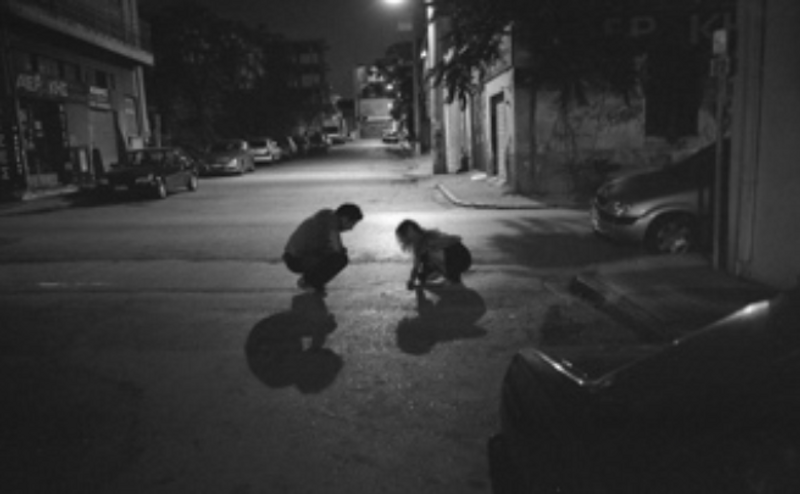
This photo is from a performance that took place nearly twenty years ago. It was part of Secret Location (2005), a series of performances by the Athens-based group F2 Performance Unit that invited audiences to unexpected city areas and non-theatrical spaces in Athens. This second iteration was a promenade performance for an audience of one through two city blocks involving encounters in different environments of the neighbourhood such as a bar, a track, a studio, a flat, a terrace, an office, a garage, an abandoned building, a car and a garden. The performance concluded with looking at the stars on a warm summer night pondering on DNA, statistics and life possibilities. The performances took place at a time when the cultural landscape in Greece was almost exclusively dominated by text-based plays and traditional theatre forms. Against this landscape, a series of emergent performance sites and practices appeared, experimenting with forms and modes of production, practising a critique to this particular landscape, to “the way things are”, to sedimented practices and to the dominant imaginary of what theatre can be or do. This critique of the landscape was not articulated in a reflexive form but rather informed processes of making – instituting critical spaces that others could inhabit.
This interrelation between critique and the emergence of critical spaces I will try to explore further in this article. This discussion deviates from notions of art criticism and artistic critique that are related to existing art works and focuses instead on a form of critique that is inherent in processes of making and organising. This form of site-specific critique, or critical situatedness, is rooted and engaged in a specific cultural landscape and manifests itself as inseparable from processes of making. I will share three instances of organising as critique that appeared at different socio-political moments during the last two decades in Greece and took different forms (performance making, critical theory, curating). These ephemeral formations were instituted against the dominant cultural imaginary and existed in a critical, deconstructive relation to it by practically creating alternative critical sites. These practices appeared in a geographical periphery but most importantly in the periphery of the system – outside the dominant cultural imaginary and established practices at the time. In what follows, through these examples, I explore this form of cultural site-specific critique that repeatedly engages with the ephemeral making of critical sites within a specific here and now. I will consider the ephemerality of these events as a fundamental element of this form of critique that repeatedly engages with a changing here and now. It is in a sense this haunting liveness, I argue, that bears the potential to produce counter-hegemonic constellations of practice which allow other politics to take form.
Restricted Area (2004)
In the early 2000s, the Greek cultural scene was dominated by traditional forms and working relations. The Athenian cultural scene mainly consisted of theatres, music venues and galleries that were located in distinct areas of the city. The dominant figure of the director/theatre owner established hierarchical working relationships in the theatre productions that they managed. In this landscape, a series of experimental practices by emergent makers appeared in the periphery of this system. Unable to access established cultural venues and production mechanisms, these makers often worked collaboratively, forming groups, collectives and companies, situated their work in unexpected locations, unknown and found spaces, and created their own DIY economies of practice by inventing distinct methods of promoting, funding and staging the work. The conditions of production, unpredicted spaces and experimental structures affected audience relations and aesthetics of the work and vice versa. An expanding audience followed them as they embarked on these ventures and supported the work that at the time was almost exclusively funded by ticket sales and voluntary contributions. At the same time, it was severely ostracized by the Athenian cultural scene and critics as being ‘not theatre’.
A few years into this development, in 2003, a group of graphic designers and artists opened a two-floor cultural venue in the centre of Athens which at first appeared indefinable. The space did not label itself as a theatre, a gallery, a music venue or a bar. Hybrid activities would pop up in various spaces of the building and draw diverse audiences. The space simply known as Bios was one of the first multi-art spaces of Athens. Bios came into being outside the culture industry – questioning the instituted modes of cultural production – and outside the established system of regulations. Since the space at the time did not fit into the existing categories of a theatre or a bar, the police might turn up and shut the venue down on any given evening for not operating with any such permits.
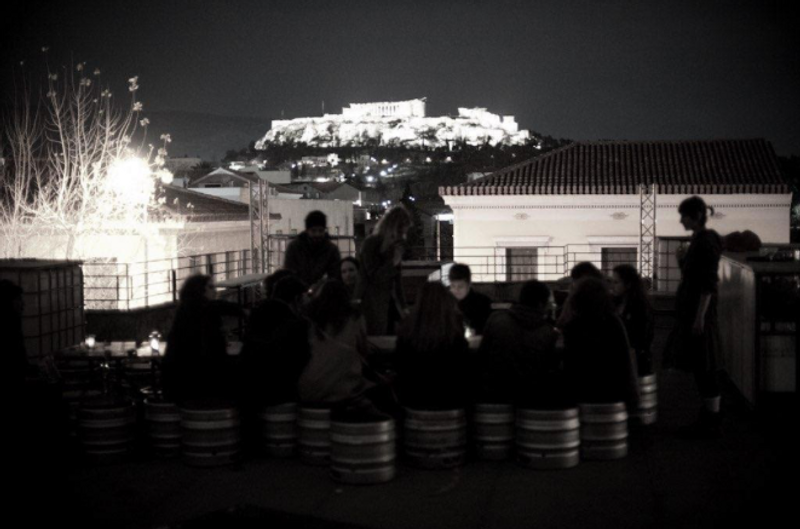
Restricted Area, F2 Performance Unit, 2004.
A few months after Bios' opening in the winter of 2014, F2 Performance Unit presented its new performance Restricted Area. F2 Performance Unit was one of the groups that appeared in the early 2000s and made collectively experimental, devised rather than text-based work, and could be widely characterised as post-dramatic performance. Unable to access theatres and other cultural venues, previous performances took place in factory spaces, offices, shops, bars, flats, and disused gardens. The research into and questioning of space and its social architectures formed a way of making, a methodology and the aesthetics of the work. Restricted Area was the fourth large scale piece and took place at a residential part of the first floor of the building of Bios which, although it was part of the cultural venue, retained the architecture of a flat. The piece worked with social architectures of a residential space, domestic economies and intimate and restricted areas, inviting spectators to explore task-based performative constructions and situations. The performance consisted of real time tasks and instructions that formed performance scores that engaged both performers and audience in an evolving composition in the here and now. These scores produced the performance through repetition, distortion and difference in open structures which the audience could navigate. Resisting the production of a singular narrative or meaning, the situations were not scripted nor acted but rather formed by real-time tasks. A couple had a fight again and again in different parts of the flat, but in this repetition nothing was ever the same; a girl kept breaking a glass of wine, doors opened and closed, inviting spectators into intimate settings, autobiographical confessions, uncanny environments, unexpected encounters, haunting again and again the rooms of the building, distorting what was real and what was part of the performance. The performance drew large and diverse audiences and produced unexpected forms of ‘inappropriate sociality’ in Haraway’s terms, in the sense of standing in a critical deconstructive relationality, ephemerally forming encounters that flee existing social constructs. These forms of critical, deconstructive relationality gave rise to visible and invisible forms of exchange and participation. At the time, both F2 Performance Unit and Bios appeared outside the dominant imaginary and yet ephemerally challenged and expanded the horizons of expectation within this specific milieu. The contextualisation of a performance that experimented with alternative forms of theatre in an experimental art space, that resisting performing an identity or categorising the work, produced an ephemeral hybrid critical site incommensurable with existing regimes, opening up space for new narratives of practice and dialogues between audiences and the work.
In the following years in Athens, more spaces and companies appeared. The paradigm of forming a performance company as a model of organising, working and creating collectively became a popular strategy for new artists as some of the emergent companies of the early 2000 began to receive bits of funding and support in 2007. Gradually, the dominant imaginary of cultural practice was challenged by emerging companies and spaces that produced new relationships with audiences, distinct spatial uses and aesthetics often resisting hierarchical working relations. Towards the end of the decade, the formal institutions and state structures seemed to be affected by the emergent practices while some of these companies in turn were incorporated into existing formal institutions. However, the continuous battle against the dominant cultural imaginary both aesthetically, spatially and socially made such practices popular to new audiences and yet increasingly precarious as their continuation was an ongoing collectively ‘individual’ struggle for survival. While these companies challenged hierarchical working relations and produced collective models of making and organising, they did however fail to come together as a whole, beyond individual/group positions, and produce wider platforms that address structural issues of the cultural landscape. Instead, they continued precariously as separate units struggling to survive and make new work, facing similar challenges in an increasingly unstable and precarious context.
Bios in the following decade gradually transformed into an established cultural venue. F2 Performance Unit received public funding in 2007 and disintegrated in 2008.
Communi(cati)on of Crisis (2010)
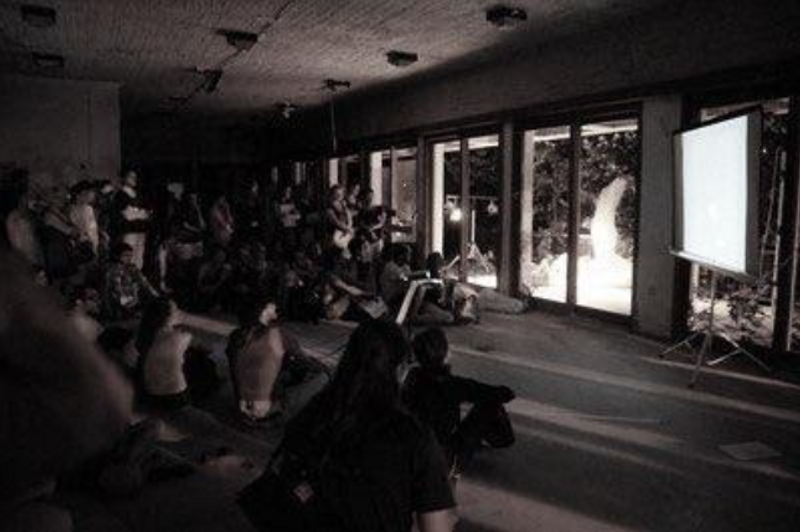
Eleven, 2011. Photo: G. Makkas.
Institute for Live Arts Research (ILAR) was an Athens-based initiative in 2010 that sought to promote and support creative dialogues between theory and practice in a landscape that was lacking a critical language for the arts. At the time, the educational system in the arts supported singular disciplinary training, clearly separating theory and practice. University departments were focused on historical research while art schools were centred on the development of artistic skills and practical training. In this landscape, ILAR sought to explore new critical methodologies in performance discourse and create opportunities for dialogue, bringing together artists, scholars, activists, other cultural practitioners and audiences.
One of the first large-scale public events that it organised was a four day symposium on “Communi(cati)on of Crisis” in the small city of Nafpaktos, bringing together artists and theorists from Greece and abroad. The event took place in the summer of 2011 while austerity policies were implemented and the economic crisis began to mark radical societal transformations in Greece. As stated in the open call:
The dominant discourse about crisis is entertained by a nostalgic yearning for healing the rift and repealing awkwardness, attenuating anomalies and regaining stability. Under this light, the current wish is to devitalize and silence the crisis, to absorb and make it disappear within a normative continuum. Another way to articulate as well as activate the crisis is by closely studying the parameters of the critical situation, by analyzing the destabilization, by addressing the critical condition at stake – in other words, by attempting to suspend it in order to open it up and create the possibility for another future […] If aesthetic expression is in general capable of provoking a critical revolutionary breakdown of ideas, forms, systems, givens and established orders, live arts in particular play a significant role in managing crises.
Communi(cati)on of Crisis, 2011
This practice of exercising the potential for other futures in the here and now – rather than a nostalgic yearning – went on to take multiple forms in Greece during the years of crisis that followed, giving rise to DIY social structures and forms of instituting otherwise. The symposium materialised with minimal resources and included over a hundred participants who presented work in panel discussions, lectures, installations, performances and workshops. It brought together artists and scholars working in Greece and abroad and produced encounters and dialogues that informed existing practices and in many cases lead to future collaborations between participants while creating a field of enquiry that was not limited to any particular practice. Exchanges happened in the here and now, as theorists rewrote papers to discuss live events that took place in the symposium, and events were reconfigured to respond to different locations and communities while informal discussions took place at communal sites, at gatherings and DIY parties.
Instead of attempting to curate a symposium, ILAR tried to situate itself in – and thus activating – a different network of spaces in crisis across the small city of Nafpaktos. The spaces themselves – such as the old mosque, the deserted Xenia Hotel, the old beach, the skateboard racks at the edge of the city, the old port, the castle and disused playgrounds – were also sites “in crisis” in the sense that they were between use and disuse, private and public, past and present. Those reactivated, in-between, liminal sites resisted categorization, restriction and exclusion, producing an ephemeral working network of spaces in the city. Unlike most public events in the Greek cultural landscape at the time, the programme was almost exclusively formed by an open call which ILAR initiated to makers, theorists and artists in Greece and abroad. The final event hosted both planned and unplanned activities which took place in close contact with local and marginalized communities.
the only thing that a work of art can make,
is to evoke yearning for another world.
And this yearning is revolutionary.
Heiner Müller, 1983, quoted in Communi(cati)on of Crisis, 2011
No Future (2016)
During the years of the economic crisis in Greece social frameworks, funding structures and infrastructures collapsed, and social imaginaries were challenged. In the meanwhile, citizens and cultural workers created self-instituted, bottom-up social structures of support and solidarity. These structures included community assemblies, medical clinics, social kitchens, medicine exchange networks, solidarity food centers, legal aid hubs and reactivated cultural venues. Concurrently in the arts, cultural workers questioned the limits of their practice and produced unexpected forms of action. Collective platforms and wider collaborative contexts emerged, engaging with cultural conditions and/or artistic practice, such as occupations, interventions, acts of institutional critique, emergent DIY performance practices and solidarity networks. After the debt referendum in 2015, the implementation of a new set of austerity policies challenged any hopes for positive transformations that the election of the left-wing government had evoked a few months beforehand. These years, while public funding for performing arts had ceased, a series of wealthy private institutions and foundations emerged. Onassis Cultural Center/Stegi opened in 2010 as an eight-floor building of 18.000 sq., just outside the city centre on Suggrou avenue. Further down the same avenue Stavros Niarchos Foundation Cultural Centre created an urban complex that included facilities for the National Library of Greece and the Greek National Opera, located within the Stavros Niarchos Park. In the dilapidated landscape of crisis, such structures inevitably dominated the landscape, offering to Greek cultural workers one of the very few possibilities for paid work and a rich programme of international work to Greek audiences while at the same time inevitably monopolising and thus de-diversifying the cultural landscape.
In this landscape, under the title No Future, a first edition of the DIY Performance Biennial took place in Athens in the summer of 2016. The event sought to playfully subvert (or even ephemerally occupy) the term “biennial” and emerged as a continuation of a series of self-organized cultural practices in the years of crisis. At a time that could be considered as a present without a future, the event sought to critically interrogate the role of performance, both historically and in the present, in relation to political and social materialities and imaginaries. It proposed a model of self-curating through assemblage, bringing together forms of artistic, political and theoretical practice and discourse in order to question the potential of a collective refusal of (an endlessly) deferred futurity. The event began from the occupied cultural space of Green Park and the nearby park of Pedion tou Areos (the second largest park of the city) before it travelled via boat from the port of Piraeus to the island of Cythera which geographically belongs to the Prefecture of Athens. It was organised without public or private support or funding and was made possible due to the generosity of participants, friends and audiences. The space was collectively organised, sharing artistic, organisation and managerial tasks between participants. The labour of making things possible was not allocated to others (technicians, cleaners and managers) but was inseparable from the realization of the artistic and theoretical work. Each morning, prior to the public programme, an assembly took place where organisers and participating artists and theorists met and organised the day ahead. Taking place in public and open spaces in the heart of the crisis, the project was open to diverse attendees and constantly affected by the urgent needs of its surroundings. In the vulnerable context of Green Park and later within the public space of the boat and at sites on Cythera, diverse and unexpected audiences mixed spontaneously, reversing expectations and the production of meaning. The event seemed to question its own potential as it appeared insufficient to produce sustainable changes in the cultural and political landscape and/or interrupt power regimes, functioning more as an exercise on how a DIY collective infrastructure might operate. Similar to other practices discussed earlier in this text, DIY Performance Biennial was not solely a space for critique but rather a space created by critique. Its temporariness and its ostensible disappearance was inseparable from what made it possible. Such practices engaged with a specific landscape and its limits often embody a critique that gives rise to a form – a situated composition that is relevant at a specific time. These compositions can be copied, incorporated, reused and made sustainable, however often losing something of their relevance in this alteration. The disappearance is integral to the (im)potentiality of such spaces of critique and can be understood both as a fundamental element of counter-hegemonic interventions and as the inability of precarious bottom-up initiatives to continue as effective counter-powers.
After the end
To write is to produce a mark that will constitute a sort of machine which is productive in turn, and which my future disappearance will not, in principle, hinder in its functioning, offering things and itself to be read and to be rewritten
Derrida, 1988:8
In diverse moments in time, these practices embodied a form of critique of the specificities of the Greek cultural landscape and its evolving imaginary. As modes of critical situatedness or site-specific critique as explained above, they intervened ephemerally on existing power regimes and dominant imaginaries, spatializing a critique by making spaces and situations that others could inhabit. These spaces appeared in the periphery – geographically and culturally – of the system and outside the dominant imaginary. Engaging with the socio-cultural impossibilities of this landscape, they materialised with minimal resources and functioned as collective infrastructures, capable of initiating forms, dialogues, encounters and leaving residues that subsequently gave rise to other contexts, structures and modes of doing that became a common place in this landscape.
Instituting an activity or a process that is in a critical relation to a specific dominant cultural imaginary is a precarious practice and bears the potential to produce new structures, new practices and even new institutions. However, the ongoing practice of instituting – the repeated critical intervention in existing dominant structures as a form of making – also results into making such practices exceedingly vulnerable as they constantly attempt to disrupt or intervene in an established status quo and power relations. Thus, such practices do not often result in successful models of sustainability. The fact that these spaces of critique often disappear indicates an ephemeral practice of continuous critical positioning that questions understandings of sustainability and affect. Simultaneously deriving and departing from the specificities of a here and now they bear the potential to affect and form constellations of practice even if the specific events and initiatives are discontinuous.
These disappearing spaces that critique creates embrace the tension between the desire of tangible alternatives and the intention to intervene in existing power regimes; embodying, on the one hand, the ghostliness of critique as a desire for ongoing critical intervention while embracing, on the other hand, the need for alternative liveable structures. In between these positions – in between ‘debt and credit’ to borrow Moten and Harney (2013) words – these disappearing spaces of critique queer understandings of what matters, what is worthwhile, what passes and what remains, what an end signifies. Other politics of life ephemerally take form, haunting the here and now. As Avery Gordon writes, haunting raises specters: “it jams time – the way we separate the past, present, and future. Ghosts appear when the trouble they represent and symptomize is no longer being contained or repressed or blocked from view. Ghosts arise or haunting occurs when repression or blockage is not working” (Gordon 2004).
Looking back. Looking forward. I started writing this text with the intention of discussing modes of performance and organising. I was thinking of what people were doing. Forms of inhabiting shared spaces. Critical forms that came out of specific needs. Need and make. Events upset calculations and events found the necessary forms. Need and make. As I was thinking through the here and now and what might be possible, I somehow returned to these impotent moments of critical situatedness that were somewhat lost, that remained almost invisible for those that didn’t experience the live event. This haunting liveness was fundamental as there was almost no documentation of these events – they didn’t promote themselves afterwards and didn’t continue in the same form. The live event is what remained: a set of tales and stories to pass on.
Fleeing “credit" and familiar ways of making sense, such modes of unsatisfied incompleteness might turn into an unsatiated potential for other spaces of critique, for new tales and stories. It is perhaps such incomplete forms of shared, haunting liveness that we turn to in order to find joy in the here and now and thus ways of making and responding that allow new politics to take form. Spaces of critique that make visible new pleasures and needs; contexts that we share with others; inhabit, transform and carry together. And again. Forms of joyful indebtedness. Haunting whatever is there. Jamming time. Disappearing spaces of critique and joy. And again.
We should keep on looking…
Bibliography
Derrida, J., (1988), ‘Signature Event Context’, in: Limited Inc, Evanston: Northwestern University Press, pp. 1-23.
Gordon, A., (2004), ‘Some thoughts on the utopian’, Anthropology & Materialism 3: Utopia: The Elsewhere and The Otherwise, 2016, available at https://journals.openedition.org/am/678 (accessed 14 July 2020).
Green Park Athens, (2015), ‘Manifesto’, https://greenparkathens.wordpress.com/manifesto/ (accessed 14 July 2020).
Harney, S., & F., Moten, (2013) The Undercommons: Fugitive planning & black study, Minor Compositions, http://www.minorcompositions.info/wp- content/uploads/2013/04/undercommons-web.pdf (accessed 14 July 2020).
Institute for Live Arts Research, (2011), ‘Communi(cati)on of Crisis’, Nafpaktos June 2001, https://liveartsinstitute.wordpress.com/symposiumsconferences/communication-of-crisis/symposium-theme/ (accessed 14 July 2020).
Lehmann, H.-Th., (2006) Postdramatic Theatre, Oxon: Routledge.
DIY Performance Biennial, (2016) ‘No Future’, Athens & Cythera July 2016, https://performancebiennial.wordpress.com/theme/ (accessed 14 July 2020).
Cf. Lehmann, H.-Th., Postdramatic Theatre, Oxon: Routledge, 2006
(BACK)- (BACK)
Green Park was occupied in May 2015 by an emerging collective of cultural workers. As stated in their manifesto ‘Almost 4 years after the occupation of the Embros theatre in 2011 we are activating with our own means a space deserted and left empty for years by the Greek state and propose a 10 day program of cultural and political intervention in the here and now of Athens. […] We look to rebuild modes of collectivity and solidarity and reclaim friendship for its political importance. We propose friendship as a model for organizational formations and autonomous instituting that exceeds neo-liberal calls to order … in a struggle against cultural and artistic monopolies, “creative cities” and their production lines of co-optation, through this ephemeral collective experiment we aim to co-imagine with fellow city dwellers, the here and now of Green Park and our city’ (Green Park, 2015). Green Park was active until the summer of 2017 and hosted numerous events including conferences, performances, talks, residencies, artistic projects, neighbourhood meetings, concerts and solidarity events.
Derrida, J., ‘Signature Event Context’, In: Limited Inc, Evanston: Northwestern University Press, 1988, pp. 1–23.
(BACK)